

An adult residential facility (ARF) provides a place to live and receive care. ARF pharmacy services help coordinate residents’ medications among facility staff, residents, and pharmacists. Clear communication supports an organized medication routine as part of daily care.
If you’re comparing ARF care with care in a residential care facility for the elderly (RCFE), this article explains what an ARF is, how pharmacy services relate to both settings, and how healthcare delivery trends are changing support for residential facilities.
Key Takeaways
- Understand how insurance, Medicare Part D, and Medi-Cal may relate to residents’ prescription needs and facility pharmacy support.
- See how pharmacy coordination can help an ARF manage prescriptions, medication information, and changes in residents’ needs.
- Learn what a pharmacist medication review can check, and how direct pharmacist access can support facility staff.
- Find out how urgent delivery works for facility partners and what to expect from Phoenix Pharmacy’s long-term care partnership.
Does ARF accept insurance, Medicare, or Medicaid?
An ARF does not have one blanket answer to whether it “accepts” insurance. The answer depends on whether you mean payment for facility care or a resident’s prescription benefit. Medicare Part D, Medi-Cal, and commercial insurance relate to prescription billing, not automatically to every charge for residential care.
For a California resident, share the applicable Medi-Cal or Medicare Part D details. These are separate programs, and coverage depends on the resident’s enrollment, plan, and medication. Don’t assume one payment route covers every prescription.
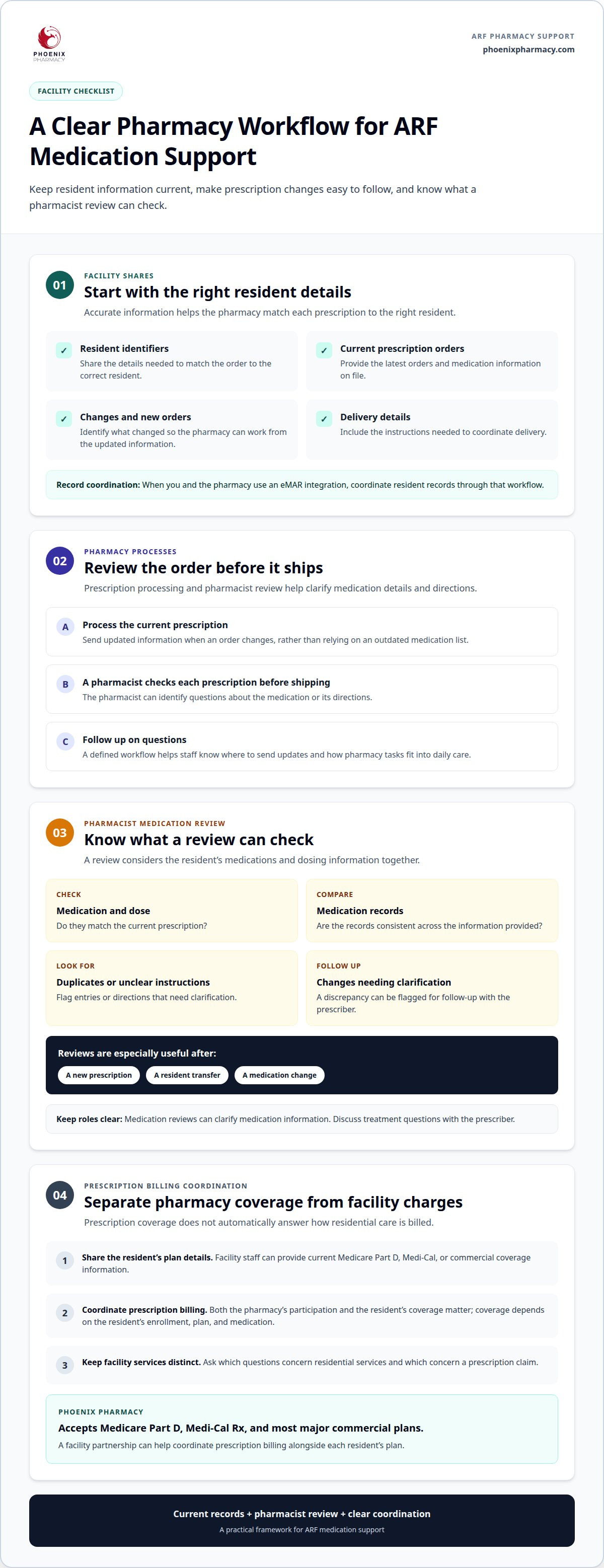
For pharmacy billing, both the pharmacy’s participation and the resident’s coverage matter. Phoenix Pharmacy accepts Medicare Part D, Medi-Cal Rx, and most major commercial plans. A facility partnership can help coordinate prescription billing alongside each resident’s plan.
To keep the billing process clear, facility staff can:
- Provide the resident’s current plan information, such as Medicare Part D or Medi-Cal.
- Share prescription details and identify any commercial coverage recorded for the resident.
- Coordinate with the pharmacy so billing follows the resident’s applicable coverage.
These steps help distinguish prescription claims from facility charges. For example, a resident may have Medicare Part D prescription coverage while the ARF handles residential services through separate arrangements. Clear plan details give the pharmacy a practical starting point for ARF pharmacy services and help staff address billing questions without assuming every resident has the same coverage.
Before making a placement decision, ask the ARF to separate each proposed charge into facility services, prescription costs, and any other item the resident or representative is expected to arrange. Request an explanation of who would bill, what plan information is needed, and what falls outside a prescription claim. If an answer refers generally to insurance, clarify whether it concerns residential services or pharmacy billing. That distinction helps avoid assuming a plan pays the entire bill. Ask how staff will confirm the resident’s plan and medication details with the pharmacy, and whom to contact if a claim is not processed as expected. Keep the response with the resident’s enrollment and billing information, and revisit these questions if those details change. These steps clarify an individual arrangement; they do not guarantee that a particular charge will be covered.
It may also help to keep payment questions separate from questions about direct care staff qualifications. In California, passing the challenge test without attending the required competency-based training does not satisfy direct care staff continuing education requirements under California Code of Regulations, Title 17, Section 56038; the stated value is 56033(a)(1) or (2). If staff training comes up while discussing a resident’s services, ask for clarification of that requirement rather than treating it as an insurance benefit or a payment method. For coverage discussions, focus on the resident’s actual plan details and the specific charge in question. Ask the facility to explain what information it needs to coordinate prescription billing, and to distinguish that process from any arrangement for residential services. A clear answer should let the resident or representative understand which questions concern the plan, which concern the pharmacy, and which concern the facility, without assuming that one answer applies to every charge.
How a pharmacy provides services to an ARF
You can arrange pharmacy support by sharing resident and facility information through an agreed workflow. Provide current medication orders, resident identifiers, delivery details, and relevant changes. Clear records help the pharmacy match each prescription to the right resident and reduce avoidable follow-up.
The pharmacy then processes orders and reviews prescription details. A pharmacist checks each prescription before it ships, helping identify questions about the medication or directions. When an order changes, send the updated information so the pharmacy can work from the current record rather than an outdated list.
Your workflow can include these steps:
- Provide resident profiles and current prescription orders through your chosen process.
- Identify new orders, changes, and delivery instructions so each request is clear.
- Coordinate records through an electronic medication administration record (eMAR), when you and the pharmacy use an integration.
For example, when a resident’s prescription changes, you can submit the revised order and update the medication record. The pharmacy can process the prescription using the new information. This coordination is especially useful when several residents have distinct prescriptions and delivery needs.
Good ARF pharmacy services connect order processing, pharmacist review, records, and delivery. You provide accurate resident information; the pharmacy processes prescriptions and communicates about questions. A defined workflow helps you know where to send updates and how pharmacy tasks fit into daily care.
How pharmacist medication reviews support ARF residents
A pharmacist’s medication review considers a resident’s medications and dosing information together. It can help identify duplicate entries, unclear instructions, or a dose that needs clarification. You can provide the resident’s medication list and current prescription information for the pharmacist to review.
Reviews are especially useful when a resident has a new prescription, a transfer, or a medication change. For example, if your facility receives an updated order, the pharmacist can compare it with the medication information on file and flag a discrepancy for follow-up. This helps you and your staff see what needs attention.
A review may focus on practical questions such as:
- Do the medication and dose match the current prescription?
- Are medication records consistent across the information provided?
- Does a change or unclear instruction need follow-up with the prescriber?
Medication reviews can help clarify medication information, while treatment questions should be discussed with the prescriber. If a review raises a question about treatment, you or your staff can follow up with the prescriber. Current records and timely updates help the pharmacist assess the right information. Prescription refills and transfers can also support continuity when a resident’s pharmacy arrangements change. The goal is a clearer medication picture for you, your staff, and residents, with questions directed to the appropriate healthcare professional. A pharmacist’s review of prescription details before shipping adds another check during preparation.
When ARF staff can reach an on-call pharmacist
If you’re ARF staff, you can reach an on-call pharmacist after hours when a medication question can’t wait for routine business hours. Long-term-care partners have 24/7 pharmacist access, including Saturdays and Sundays. You can speak directly with a pharmacist familiar with your facility’s pharmacy workflow.
Direct access can help when you need to clarify prescription instructions, report an order change, or raise a delivery concern. For example, if an order’s directions differ from your facility record, describe the discrepancy and ask the pharmacist to review the prescription information.
For a useful call, have the relevant details ready:
- The resident’s identifying information and medication name.
- The current prescription instructions and your question or the discrepancy.
- Any recent order update or delivery issue related to the concern.
The pharmacist can address pharmacy and prescription questions and explain any needed follow-up. Questions about diagnosis or treatment changes belong with the resident’s prescriber. This keeps the pharmacist’s role clear while giving you a knowledgeable contact for medication coordination.
Direct access matters most when a routine process meets an after-hours exception. You can describe the issue, get pharmacy guidance, and keep your facility’s medication communication moving without waiting for the next business day. For long-term-care partners, around-the-clock access gives your care team a direct channel for prescription support whenever questions arise.
How STAT delivery supports ARF medication needs
STAT delivery gives long-term-care partners a way to request urgent medication delivery when routine cycles won’t meet a resident’s need. Examples include a newly received prescription or an order change that leaves the facility needing medication sooner. You can submit the order through your facility’s electronic medication administration record (eMAR), so the pharmacy can begin processing it.
For facility partners, Phoenix Pharmacy’s STAT delivery target is 4 hours, measured from eMAR order entry. The clock starts when you enter the order, not when you first identify a need or begin preparing a request. Accurate order details and timely entry help keep the process moving.
In practice, submit the current prescription order and mark the urgent need in your facility’s workflow. The pharmacy can then process the prescription and coordinate delivery. If a question arises about the prescription, pharmacist communication can help clarify the pharmacy-related issue. Treatment decisions remain with the resident’s prescriber.
STAT delivery is designed for time-sensitive prescription needs, rather than replacing routine medication planning. For example, you can use your facility’s regular process for scheduled refills and reserve urgent requests for situations where the medication is needed sooner. A defined eMAR process gives you and the pharmacy a shared starting point, while the 4-hour target sets a clear expectation for LTC partners. The target supports planning, but it is not a substitute for clear orders or communication.
Phoenix Pharmacy
Phoenix Pharmacy is a practical next step when your ARF needs a pharmacy partner for resident prescriptions. Its long-term-care pharmacy partnership connects prescription processing with the facility’s medication workflow, giving staff a pharmacy contact for routine needs and coordination.
For example, the pharmacy supports prescription refills and transfers as residents’ needs or pharmacy arrangements change. Staff can share current prescription information and facility procedures, helping the pharmacy understand how orders are handled. Clear communication helps keep medication records and prescription requests aligned.
Phoenix Pharmacy also offers the Phoenix Rx Kiosk and Metagenics products, including Adrenogen and Adreset. These serve different needs: the kiosk provides prescription pickup in Thousand Oaks, California, while the products are available through the pharmacy’s online shop. For ARF prescription support, the long-term-care pharmacy partnership is the relevant starting point.
Before moving forward, consider what your facility needs from a pharmacy relationship: prescription coordination, refills and transfers, or a clear contact for pharmacy questions. Explain your current workflow and what would make medication coordination easier. This helps establish whether the partnership fits your facility’s needs, without confusing pharmacy support with medical diagnosis or prescribing.
For a straightforward next step, contact Phoenix Pharmacy to discuss pharmacy support for your ARF.
Frequently Asked Questions
What is an ARF?
ARF stands for adult residential facility, a residential setting for adults who need support with daily living or care. It provides a place to live outside a hospital. Staff coordinate support around your needs, while your medication and healthcare decisions remain individual. The abbreviation names the facility type, not a specific prescription, insurance plan, or level of pharmacy service.
What does ARF mean in pharmacy services?
In pharmacy services, ARF means adult residential facility. It identifies the setting receiving pharmacy support, not a medication category or insurance program. ARF pharmacy services describe prescription support organized for you in that setting. Pharmacy workflows serve you and others living in the facility, while diagnosis and treatment decisions remain with the appropriate healthcare professionals.


