

A pharmacist video prescription review examines whether a script and finished video present medication information clearly and accurately. The U.S. Bureau of Labor Statistics explains that pharmacists check allergies, medical conditions, and other medications to help prevent adverse reactions to newly prescribed drugs. This guide covers what a pharmacist may review in the script and final cut, and what can affect a video’s length and production timeline.
Key Takeaways
- Learn which patient and medication details a pharmacist reviews to spot potential safety concerns in a prescription video.
- See what information can help make an online pharmacist review more focused and useful.
- Understand why a video review does not automatically mean a pharmacist can prescribe or renew medication.
- Find out when Phoenix Pharmacy’s prescription refill and transfer services may fit your medication needs.
What happens during a video prescription review with a pharmacist?
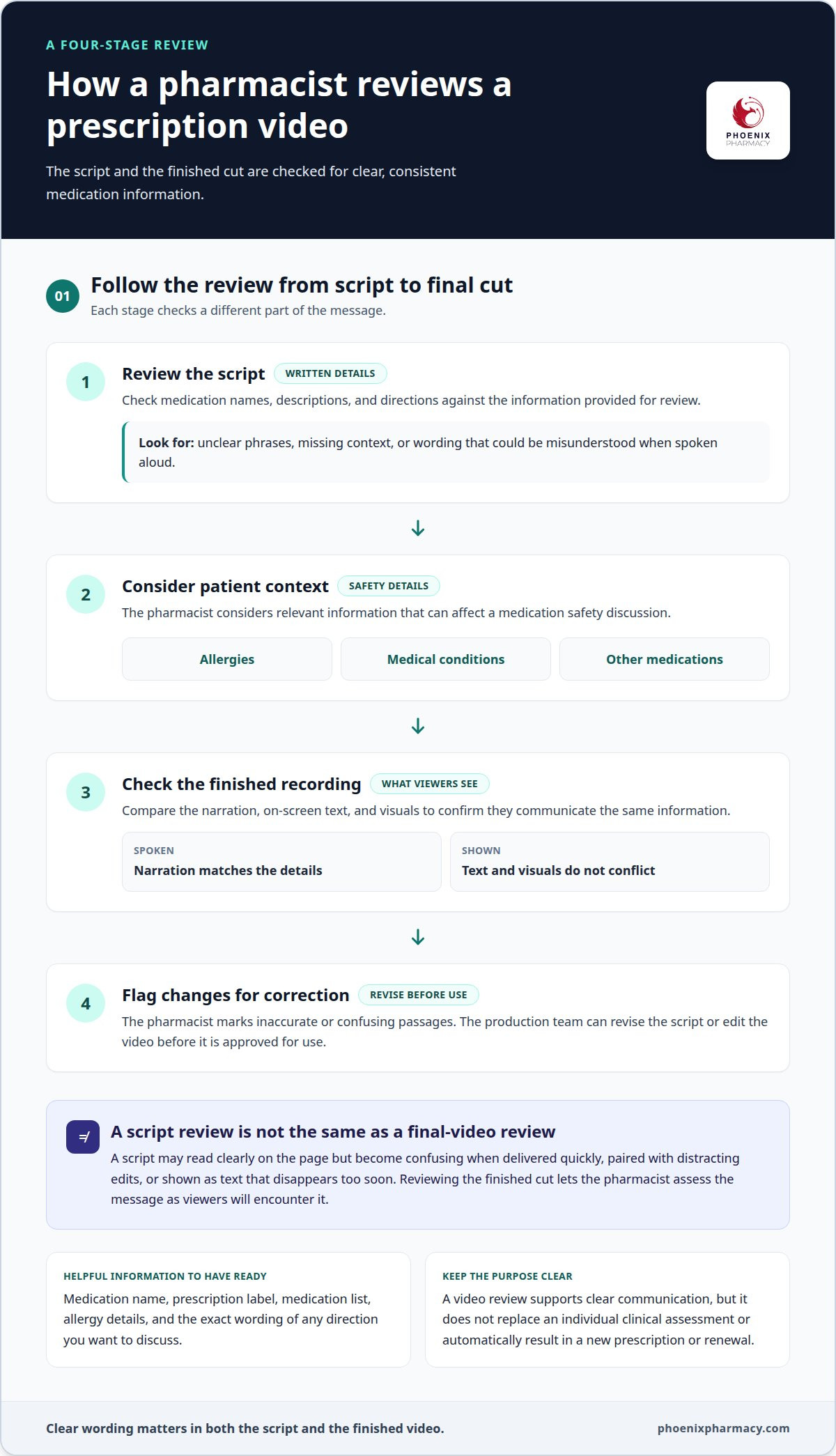
During a pharmacist video prescription review, the pharmacist examines both the script and the finished cut. The U.S. Bureau of Labor Statistics notes that pharmacists check allergies, medical conditions, and other medications to help prevent adverse reactions to newly prescribed drugs. The review also checks whether the narration matches the prescription details.
The process starts with the script, where every medication reference needs clear, consistent wording. The pharmacist considers whether spoken directions match the information the video is intended to explain. A phrase such as “take as directed” may need context to make its meaning clear to viewers. The reviewer also flags wording that could sound broader or more certain than intended.
- Review the script. The pharmacist checks medication names and descriptions against the details provided for review. They flag unclear phrases, missing context, or statements that could be misunderstood when spoken aloud.
- Check the patient context. Allergies, medical conditions, and other medications can affect the safety discussion. The pharmacist considers whether the script reflects the relevant details rather than treating the prescription in isolation.
- Review the recording. In the finished video, the pharmacist checks whether narration, on-screen text, and visuals communicate the same information. For example, a label shown onscreen should not conflict with the spoken explanation.
- Identify needed changes. The pharmacist marks inaccurate or confusing passages for correction. The production team can then revise the script or edit before the video is approved for use.
Script review and final-video review serve different purposes. A script may be accurate on the page but confusing when delivered quickly, paired with distracting edits, or displayed as text that disappears too soon. Reviewing the finished cut lets the pharmacist assess the message as viewers will encounter it. Clear wording matters in both formats.
The Federal Trade Commission warns that inadequate review of medical history can create a risk of injury. A video review supports clear communication, but it does not replace an individual clinical assessment. The specific review steps depend on the medication information and patient context available to the pharmacist.
Survodutide met noninferiority for 5-point major adverse cardiovascular events in adults with obesity and established cardiovascular disease or elevated risk.
A 40-hospital collaborative is mapping care gaps for patients with HFpEF and HFmrEF.
How do I book an online pharmacist prescription review?
Start on the pharmacy or health service’s online booking page. Choose the option for a pharmacist video consultation or prescription review. Booking labels vary, so select the service that matches your need. For example, a medication question differs from a request to discuss a new prescription. If several appointment types are listed, read their descriptions before choosing.
Next, complete the intake form with the requested details. Provide the medication name, the reason for your appointment, and a brief description of your question. Include relevant context, such as a new prescription or a concern about combining medicines. If the form provides a secure way to share prescription details or medical history, use it to give the pharmacist useful context before the call.
- Choose a time. Select an available appointment slot and enter your contact details. Confirm the time zone if you’re booking while traveling or from another state.
- Review the confirmation. Check the appointment date, video instructions, and any preparation steps. Save the confirmation so you can find the meeting details later.
- Gather relevant information. Keep the prescription label, medication list, and allergy details nearby. If your question concerns a particular direction, note the exact wording on the label.
- Join the video call. Open the meeting link using the instructions provided. Be ready to describe your question and clarify details the pharmacist asks about.
A focused appointment starts with a clear question. You might ask how to understand a specific direction or what information to discuss about a newly prescribed medicine. The pharmacist can use your medication details and health context to guide the conversation. A video visit works best when you can hear the discussion and read the prescription label. If someone helps manage your medicines, have them available to clarify your routine. After the review, keep any instructions or follow-up steps with your medication records.
Can a pharmacist prescribe or renew medication after a video review?
A video review and a prescription are separate actions. During a call, a pharmacist can assess medication information, explain directions, and discuss concerns. The review alone does not mean that a new prescription or renewal will follow. Asking about a medicine’s label, for example, differs from requesting a new medication. The next step depends on the appointment’s purpose and the pharmacist’s prescribing authority under applicable state rules.
Keep these distinctions clear during the call:
- Medication education: The pharmacist explains the prescription, such as what a direction on the label means.
- Safety review: The pharmacist considers medication details and health context, then discusses concerns or possible next steps.
- Renewal request: A request to continue an existing medication is not automatically approved during a video visit.
- New prescription: Starting a medication is a separate decision from reviewing an existing prescription or explaining its use.
If you need a renewal, say so clearly at the start of the appointment. Share the medication name and explain whether you’re asking about an existing prescription or a new treatment. That distinction helps the pharmacist address the right task. If the question requires a prescriber’s decision, the pharmacist can explain that the video discussion itself does not complete the prescribing request. Don’t treat medication advice as proof that a prescription was issued.
Before ending the call, confirm the outcome in plain terms. Ask whether the pharmacist provided medication guidance, approved a renewal, or identified another step. Treat a prescription as issued only after the appropriate prescribing process has taken place. If you’re unsure, check the pharmacy’s prescription record or the appointment instructions. Clear follow-up helps distinguish a useful review from a completed prescription request.
The Federal Trade Commission warns that prescriptions issued without adequate review of a consumer’s medical history can pose a significant risk of injury. A video review should therefore consider relevant medical history before you rely on a prescribing decision. If that history has not been considered, clarify what information is still needed and what follow-up is appropriate before treating the request as resolved.
What rules govern telepharmacy and video consultations in each state
Telepharmacy and video consultation rules vary by state. A pharmacist serving a patient across state lines must account for the rules that apply to the service and location. Those rules can affect what the pharmacist may do during a video call, including whether it is limited to medication guidance or involves another professional action. The same appointment format does not grant identical authority in every state.
Rules may address several parts of a remote pharmacy service, including pharmacist qualifications, patient counseling, prescription handling, and records. A video platform is only one part of the process. The pharmacist’s role and the service being provided matter as well. A medication discussion, refill request, and new prescription are distinct tasks, as the previous section explains.
To understand which rules apply, follow the service from start to finish:
- Identify the locations. Note where you are during the consultation and where the pharmacist is practicing. A call taken while traveling could involve a different state than one taken at home.
- Define the request. Separate questions about medication directions from a request for a renewal or new prescription. The type of service affects which professional rules are relevant.
- Clarify the pharmacist’s role. Confirm whether the appointment provides medication counseling, prescription review, or another service. A video meeting alone does not establish prescribing authority.
- Understand the follow-up. Ask what the pharmacist can address during the call and what steps apply if your request needs a separate prescribing decision.
For example, a patient asking about a prescription label is seeking guidance. A patient requesting a new medication is asking for a different professional action. State requirements can shape how each request is handled, so assuming the same rules apply nationwide can mislead. Distinguish the consultation from any prescription decision, then clarify the pharmacist’s role for your specific request.
For a residential care facility, the same distinction matters when arranging remote pharmacy support. Specify whether staff need medication guidance, prescription coordination, or another service. Clear service boundaries help facility teams understand what a video consultation covers and where follow-up decisions belong.
Phoenix Pharmacy: Prescription refills and transfers
Phoenix Pharmacy handles prescription refills and transfers when you need to continue or move an existing prescription. A video review can clarify medication information, while a refill or transfer addresses a separate pharmacy need. For a transfer, share the prescription details and the pharmacy currently filling it so the request can be directed appropriately.
Most prescription transfers are ready the same day. Controlled-substance transfers may take 24-48 hours. If you’re moving a prescription, allow time for that process and keep your current supply in mind. The Phoenix Rx Kiosk is another option for prescription access.
For supplement needs, Phoenix Pharmacy also offers Metagenics Adrenogen and Metagenics Adreset. If you need help with an existing prescription or want to request a transfer, contact Phoenix Pharmacy.
Choose the right next step for your prescription
Match your next step to your need. Use a pharmacist video prescription review to clarify medication information, and handle prescription access as a separate task. Phoenix Pharmacy offers prescription refills and transfers, as well as the Phoenix Rx Kiosk for prescription access. It also offers Metagenics Adrenogen for supplement needs.
Phoenix Pharmacy’s team brings practical pharmacy experience to helping people navigate prescription questions and everyday medication needs. Keep your request focused: explain whether you need help with an existing prescription, a transfer, or another pharmacy option. That gives the conversation a clear place to start without confusing medication guidance with a prescribing decision.
If you’re ready to discuss your next step, contact Phoenix Pharmacy about a review. A clear question is a good place to begin.
Frequently Asked Questions
What is a pharmacist video prescription review?
A pharmacist video prescription review is a remote conversation in which a pharmacist discusses prescription details with you by video. It can clarify how a prescription is handled and give you a chance to raise medication questions directly. The pharmacist’s role depends on the service being provided. A review does not automatically result in a new prescription or medication renewal.
Can pharmacists review prescriptions through video visits in the United States?
Yes. Pharmacists can review prescriptions through video services, though the specific service and professional actions depend on applicable state rules. Phoenix Pharmacy’s Rx Kiosk provides one example: a licensed pharmacist reviews prescriptions over video before medication is dispensed nationwide. A video review supports the pharmacy process, but it does not by itself mean a prescription has been issued or renewed.


