

ALF and LTC claim resolution starts with matching each prescription to the resident’s coverage, addressing the rejection reason, and obtaining prior authorization when the plan requires it. Effective pharmacy insurance billing keeps these steps connected.
Resolving a claim can involve repeated delays and follow-ups, especially when a rejection requires more than a simple resubmission. A clear workflow identifies the issue, assigns it to the right person, and tracks the claim through the next response.
This article explains how prescription claims move through pharmacy benefit systems, what common rejection messages may mean, how coverage and quantity limits are checked, and where prior authorization fits. You’ll see what a pharmacy partner handles, what information your facility provides, and how these steps support claim resolution.
Key Takeaways
- Tell prescription claims apart from medical claims so each follows the right billing path.
- See how pharmacy systems and PBM portals help staff track claim responses and next steps.
- Learn what rejection messages can signal and how targeted follow-up can move a claim toward resolution.
- Understand how Phoenix Pharmacy’s prescription refills and transfers and Phoenix Rx Kiosk can support your pharmacy needs.
Pharmacy medical billing compared with prescription billing
Pharmacy insurance billing follows the prescription benefit or, for some drugs, the medical benefit. The benefit determines how the claim is routed, coded, and reviewed for coverage.
Medical and Pharmacy Benefit Differences
A pharmacy benefit manager (PBM) processes prescription claims under a pharmacy benefit, while a health plan covers eligible care billed under a medical benefit. Pharmacy claims are typically approved or denied almost instantly. Under the pharmacy benefit, claims include the drug’s National Drug Code (NDC), and the pharmacy bills for the medication and dispensing services. The benefit determines the claim’s route and requirements.
Medical Billing Codes for Drugs
Medical-benefit drug claims use Healthcare Common Procedure Coding System (HCPCS) codes for drugs and related administration. CPT codes describe services such as vaccine administration or medication therapy management. For example, CPT 90471 represents administration of a single vaccine or toxoid, while CPT 90472 represents each additional one. In buy-and-bill, a provider obtains and administers the drug, then bills the insurer. Medicare Part B reimburses eligible outpatient drugs at average sales price plus a 6 percent markup. Correct coding and NDC reporting help prevent avoidable denials.
Prior Authorization and Medication Coverage
Prior authorization is a plan review required before coverage proceeds for some medications. A plan may require a patient to try a less expensive medicine first. The pharmacy or prescriber submits the requested information for review. If approved, the claim proceeds under the applicable benefit. For a drug administered in a clinical setting, medical-benefit codes may apply instead. This review affects both coverage and the claim’s next steps.
Coverage Across Insurance Benefit Types
Commercial insurance follows each plan’s terms; Medicare Part D provides prescription drug coverage, while Medicaid coverage varies by program. Copays are set amounts, deductibles apply according to plan terms, and coinsurance is a share of the covered amount. Which applies depends on the plan design. To coordinate secondary insurance, the pharmacy bills the primary plan first, then uses its response to submit the remaining claim information to the secondary plan. This sequence matters when two plans cover a prescription.
Pharmacy management system and PBM portal workflows
A pharmacy management system records prescription activity, while a pharmacy benefit manager (PBM) portal returns claim decisions and correction details. Together, they give billing staff a clear record from submission through payment or denial.
Denial Management and Claim Resubmission
Denial management means reviewing a rejected claim, correcting the cause, and resubmitting it when appropriate. The pharmacy system may show the claim response, while the PBM portal provides payer-specific details. Staff can compare those details with the prescription and patient record, correct an entry, or route a coverage issue for follow-up. Medical billing reimbursement can take months when a denied claim needs resubmission, so tracking each response helps keep unresolved claims visible.
Revenue Cycle Management
Revenue cycle management follows a claim from submission through adjudication, payment posting, or denial resolution. A pharmacy team can use system queues to separate claims awaiting a response from those needing staff action. For example, a specialty medication claim may need a coverage review before it can move forward. Billing issues can take 5-15 hours per pharmacy per month, making clear ownership and status tracking useful for keeping work from stalling.
Audit Risks and Documentation
Audit risk grows when the claim record does not clearly support what the pharmacy submitted. A useful file connects the prescription, claim details, payer response, any correction, and the dispensing record. For a resubmitted claim, staff should retain the original rejection and explain why the claim was revised. Keep records that support the billed transaction and show how staff handled the payer’s response. The plan’s audit request determines which records apply.
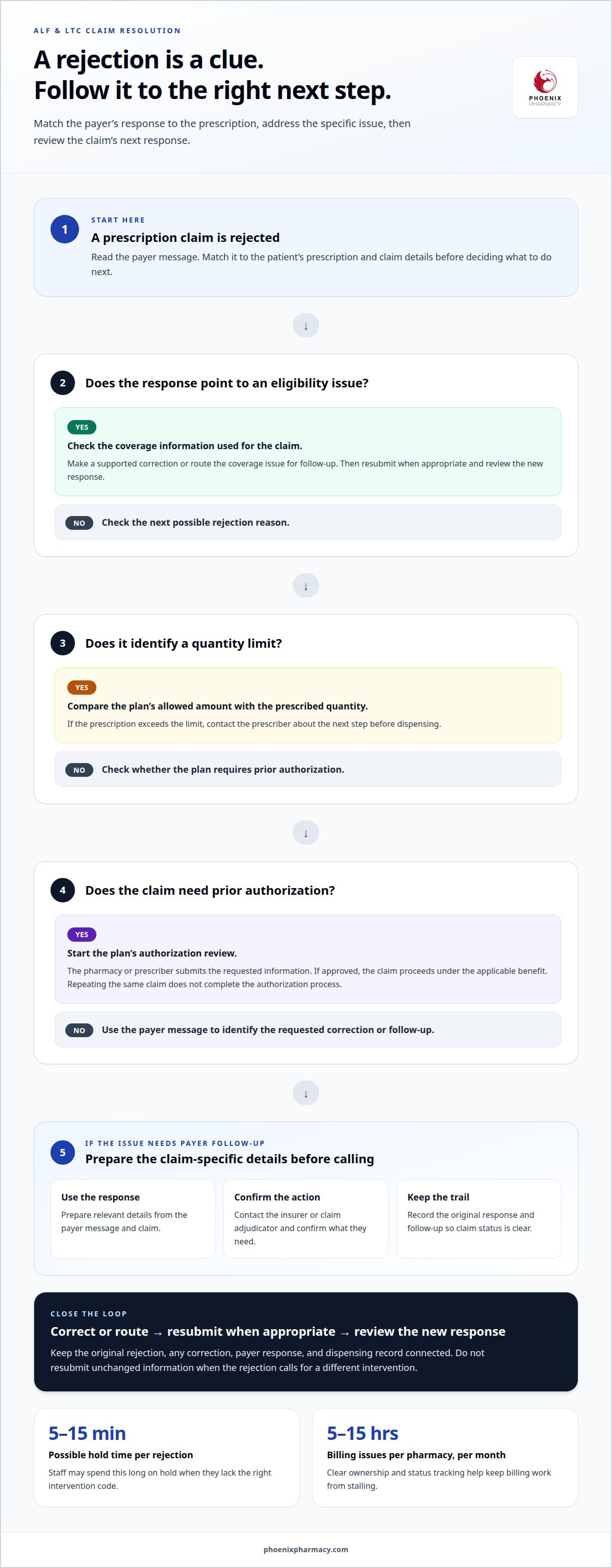
How a pharmacy billing team identifies and resolves insurance rejection codes
A rejected prescription claim returns a response that helps billing staff identify the problem. The team reads the payer message, matches it to the patient’s prescription, and determines what needs attention before resubmitting. The response may point to eligibility, quantity limits, or prior authorization. Each issue calls for a different correction, so staff should not resubmit unchanged information.
The team then compares the response with the claim details. For example, a quantity-limit rejection calls for checking the plan’s allowed amount against the prescribed quantity. If the prescription exceeds that limit, the pharmacy contacts the prescriber about the next step before dispensing. An eligibility issue instead requires checking the coverage information used for the claim. These distinctions help staff route the problem appropriately rather than treating every rejection alike.
Once staff identify the cause, they make a supported correction or route the issue for follow-up. They then resubmit the claim and review the new response. A prior-authorization rejection, for example, requires the authorization process, not repeated submissions of the same claim. The team records the original response and follow-up so facility staff and the patient can understand the claim’s status.
Some rejections need direct follow-up with the insurer or claim adjudicator. Pharmacy staff may spend 5-15 minutes on hold for each rejection when they lack the right intervention code. A billing team can use the response message to prepare the relevant details before calling, then confirm the payer’s requested action. This keeps the next step tied to the specific claim, rather than delaying resolution with a generic inquiry.
How a pharmacy billing team verifies insurance and manages prior authorization
Before processing a prescription, the billing team checks the patient’s plan information and submits the claim for a coverage response. That response can show whether the medication is covered and whether a restriction applies. Using available plan information, the team can also review whether the pharmacy is in the plan’s network. This helps identify coverage issues before dispensing.
A plan’s benefit design and the medication’s coverage status affect how a claim is handled. A pharmacy can explain the response it receives, including any coverage conditions shown for that claim. For example, the response may change after the plan’s deductible is met. The response applies to that prescription and plan, not to every medication or plan.
Prior authorization is a plan review required for some medications before coverage proceeds. The team identifies the requirement from the claim response and routes the needed information through the authorization process. A plan may also set a quantity limit. Staff compare the prescribed amount with the plan’s limit and contact the prescriber if it is exceeded. This links the coverage decision to the actual prescription.
Complex requests need clear follow-through. The team tracks whether authorization is pending, approved, or declined, then processes the claim according to the plan’s response. If a medication is not covered under the pharmacy benefit, the response helps identify the next coverage question instead of assuming reimbursement. For a resident in an ALF or LTC setting, coordinating prescription details, the plan response, and prescriber communication keeps the claim status clear for facility staff.
Phoenix Pharmacy
Phoenix Pharmacy is a next step when prescription billing questions are part of an ongoing pharmacy relationship. Its long-term care pharmacy partnership supports facilities coordinating residents’ medication services. Individuals can also use Phoenix Pharmacy for prescription refills and transfers. The right fit depends on your setting and pharmacy needs.
For ALF and LTC teams, a pharmacy partnership brings prescription dispensing into an ongoing working relationship. Your facility can discuss how residents’ prescription needs fit that arrangement. Sharing resident changes promptly helps the pharmacy and facility stay aligned. The pharmacy team can help organize prescription requests while the plan remains responsible for coverage decisions.
Individuals who need a refill or want to transfer a prescription can use Phoenix Pharmacy for those services. The Phoenix Rx Kiosk offers another way to pick up prescriptions. Phoenix Pharmacy also sells Metagenics Adrenogen and Metagenics Adreset. These supplements serve different needs, so choose based on your request rather than treating them as a substitute for prescription care.
For a facility, a useful next conversation is how a long-term care pharmacy relationship can fit its prescription workflow. For an individual, it may be a refill or transfer. Phoenix Pharmacy’s team can help you discuss the pharmacy service that matches your need. Contact Phoenix Pharmacy to talk through your pharmacy needs.
Frequently Asked Questions
How do you handle ALF and LTC claim resolution?
ALF and LTC claim resolution works best when billing follows the facility’s medication cycle and resident records. A pharmacy team can align claims with cycle-fill schedules, such as 7-day, 14-day, or 30-day cycles, and account for changes between cycles. A resident admitted or discharged mid-cycle may need separate attention so medication quantities and claim timing match the current care arrangement.
What is pharmacy insurance?
Pharmacy insurance is prescription drug coverage provided through a health plan. It helps pay for eligible medications according to the plan’s terms, which may include a formulary, the plan’s list of covered drugs, and rules for brand-name or generic medicines. Coverage is not the prescription itself: an authorized prescriber issues the prescription, and the plan determines its benefits.
How does pharmacy insurance billing work in the United States?
In the United States, prescription coverage may come through commercial insurance, Medicare Part D, or Medicaid. The benefit type and the member’s specific plan determine which medications qualify and what conditions apply. For example, a person with Medicare may enroll in Part D for prescription coverage, while a commercial plan sets its own drug benefit. Medicaid prescription coverage depends on the applicable state program.
What information is needed to bill a prescription to insurance?
Have the current insurance card and prescription details ready. The pharmacy may need the member identification and plan routing details shown on the card, the patient’s name and date of birth, and the prescribed drug and quantity. For a facility resident, current enrollment information is especially useful after a plan change. A readable card image can help prevent transcription errors.
How do pharmacies submit prescription claims to insurance companies?
Pharmacy staff enter prescription and coverage details into their billing system, which routes the claim to the appropriate payer or benefit manager. The system records the payer’s response with the prescription. If the patient has primary and secondary coverage, the pharmacy coordinates the claims, using the primary plan’s response for the next submission. The pharmacy then records the outcome for that fill.


