

Hospice pharmacy services support patients receiving hospice care, along with the clinicians and caregivers coordinating medications for comfort and symptom relief. The Centers for Medicare & Medicaid Services describes hospice eligibility as a terminal illness with a prognosis of six months or less if the illness runs its normal course. Clear medication coordination helps care teams organize prescriptions and caregivers understand the plan. This article explains how hospice pharmacy services support medication coordination, comfort kits, medication reviews, and care across hospice settings.
Key Takeaways
- Recognize when hospice care teams and caregivers may need pharmacy support coordinating medication delivery.
- Learn how symptom-management expertise and formulary planning can support a hospice care plan.
- See how comfort kits can help teams prepare for common medication needs.
- Understand how an independent pharmacy partnership can fit a hospice agency’s workflow and network.
Who Needs Hospice Pharmacy Services?
Patients receiving hospice care may need pharmacy support as symptoms and medication orders change. The Centers for Medicare & Medicaid Services describes hospice eligibility as a terminal illness with a prognosis of six months or less if the illness runs its normal course. Caregivers and clinical teams also need clear coordination to keep medication instructions aligned.
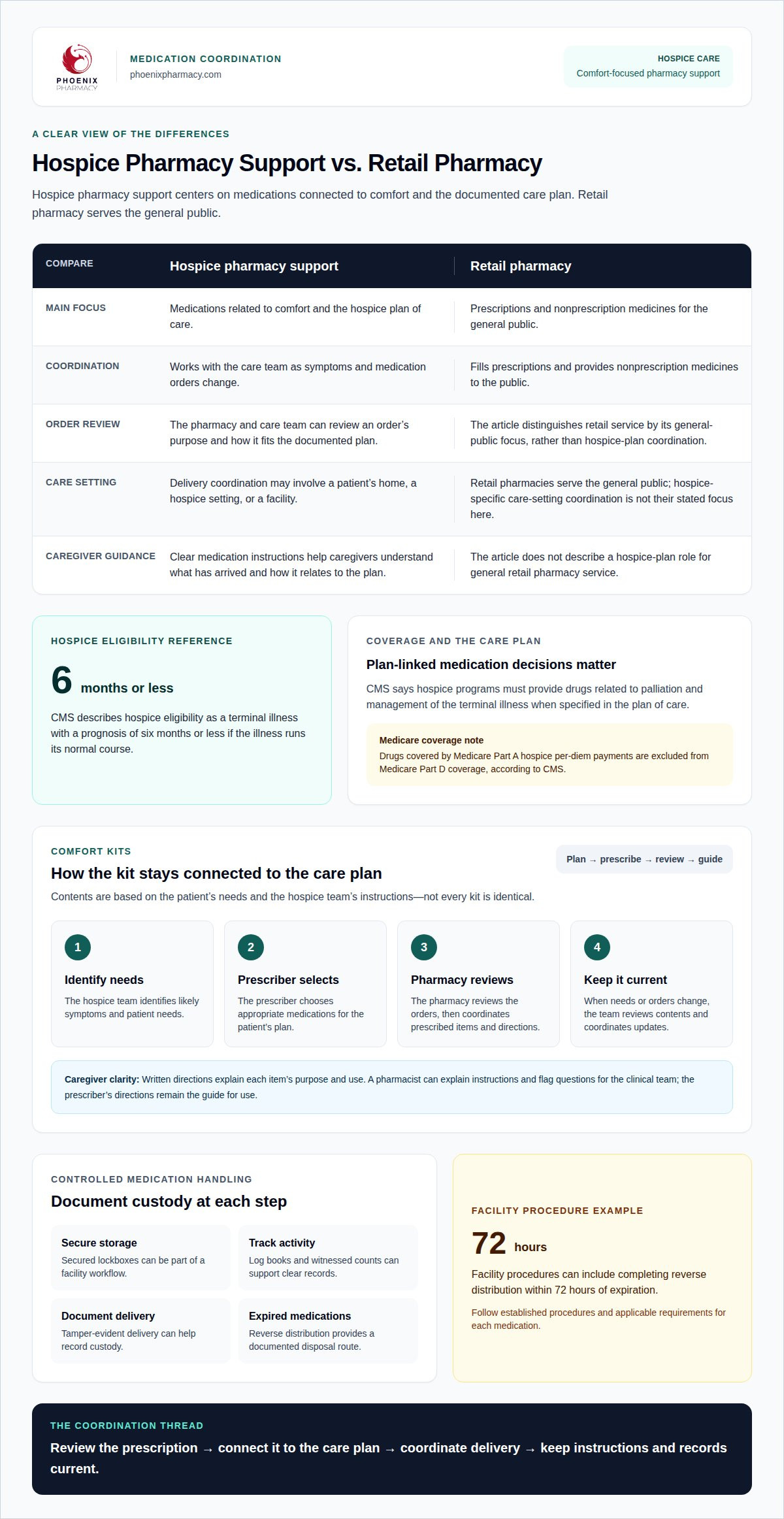
Hospice pharmacy services differ from retail pharmacy services in their focus. Retail pharmacies serve the general public with prescriptions and nonprescription medicines. Hospice pharmacy support centers on medications related to comfort and the hospice plan of care, coordinating with the care team as needs change.
Delivery matters when a patient receives care at home, in a hospice setting, or in a facility. A clear workflow covers receiving and reviewing the prescription, coordinating delivery to the patient’s care setting, and communicating what has arrived and what instructions came with it.
Medication references and drug-use tools can give hospice staff a shared source of information. A nurse reviewing an order, for example, can use medication guidance to prepare questions about instructions or potential interactions. These tools support clinical discussions but do not replace pharmacist guidance.
Care-plan technology can help teams organize medication orders alongside a patient’s documented hospice plan. The pharmacy and care team can review an order’s purpose and relevant coverage before dispensing. The Centers for Medicare & Medicaid Services states that drugs covered by Medicare Part A hospice per-diem payments are excluded from Medicare Part D coverage.
Medication information should be clear to caregivers, too. A pharmacist can explain an instruction or flag a potential interaction for the clinical team to review. A new order alongside an existing medication, for example, calls for careful review before the care team proceeds.
Comfort-care and symptom-management expertise
Pharmacy support connects medication decisions with comfort goals and the documented care plan. The Centers for Medicare & Medicaid Services says hospice programs must provide drugs related to palliation and management of the terminal illness when specified in that plan.
Palliative Symptom and Disease Management
When symptoms or orders change, a pharmacist can review prescriptions with the clinical team. The team considers each medication’s purpose, current instructions, and place in the patient’s plan. A new prescription, for example, can prompt a review of how it fits alongside existing orders. Look for clear communication among the pharmacist, prescriber, and hospice staff.
Hospice Pharmacy Management
Hospice pharmacy management coordinates prescription review, dispensing, medication records, and updates for care teams. Pharmacy management software can organize orders and show staff which instructions have changed. An updated record, for example, helps the team distinguish a current prescription from an earlier order. Choose a workflow that makes changes visible to the people who need them.
A customized formulary gives a hospice program a planned selection of medications suited to its prescribing patterns. The agency and pharmacy can review common comfort-care needs and set a process for requests outside the formulary. When practice needs change, they can review the selection and communicate approved updates to prescribers and staff.
Controlled substances require documented handling. A facility workflow can include secured lockboxes, log books, witnessed counts, and tamper-evident delivery. For expired controlled substances, reverse distribution provides a documented disposal route; facility procedures can include completing it within 72 hours of expiration. Clear records help staff track custody and reconciliation. Hospice teams should follow their established procedures and applicable requirements for each medication.
Comfort kits
A comfort kit is a planned supply of medications for symptoms that may arise during hospice care. Its contents depend on the patient’s care plan and the hospice team’s instructions. A clinician may identify a symptom to address and specify which medication belongs in the kit. The pharmacy coordinates the prescribed items and provides directions for use.
Preparation begins with the hospice team identifying a patient’s likely needs. The prescriber selects appropriate medications, and the pharmacy reviews the orders before dispensing. A caregiver can then receive information about each item, including its purpose and instructions. This process ties the kit to the patient’s plan rather than treating every kit as identical.
Clear labels and medication information matter when a caregiver needs to find the right item. If a patient develops a symptom covered by the plan, for instance, the caregiver should follow the written directions and contact the hospice team with questions. A pharmacist can explain instructions and flag questions for the clinical team, but does not replace the prescriber’s directions.
Hospice staff should review kit contents when a patient’s needs or orders change. The team confirms which medications remain part of the plan and coordinates updates with the pharmacy. This helps prevent outdated instructions from being confused with current orders. A well-coordinated comfort kit keeps its medications and guidance connected to care-plan decisions.
Hospice pharmacy inventory should be planned around hospice prescribing patterns, including comfort-care and symptom-management medications. Planning inventory around these prescribing patterns keeps comfort-care and symptom-management medications central to stocking decisions. This consideration connects pharmacy inventory planning with the medications that may be included in comfort kits for hospice patients.
Independent pharmacy and hospice agency partnerships
An independent pharmacy and hospice agency can build a partnership around medication access, clinical communication, and the agency’s care model. The agency can share its prescribing patterns and care-plan workflow, while the pharmacy uses that information to guide formulary planning and order coordination. The aim is a defined process, not a handoff that leaves staff guessing.
Start with the formulary. The hospice team and pharmacy review commonly prescribed medications, comfort-care needs, and how exceptions are handled. If a prescriber orders a medication outside the agreed formulary, the pharmacy needs a clear way to alert the clinical team and coordinate next steps. Updates should reach the people who write, review, and dispense prescriptions.
The pharmacy’s delivery model also needs to fit the agency’s care settings, including home hospice and residential facilities. Partners can map where orders go, who receives them, and how staff report a delivery issue. They should also establish how medication questions move among pharmacists, prescribers, and hospice nurses.
When choosing hospice pharmacy services, focus on practical fit: formulary coordination, delivery to your care settings, and direct communication with the clinical team. A nearby address alone does not show whether a pharmacy can support your workflow.
Technology can make the partnership easier to manage. If the agency uses electronic medication records, partners can define how prescription details and changes move through the workflow. A useful setup makes current orders easy to identify and gives staff a clear way to resolve discrepancies. Treat these as practical planning questions, not software features to assume.
Effective hospice pharmacy services depend on shared responsibility. The agency explains patient-care needs, and the pharmacy supports dispensing and medication coordination. Together, they review what works, address gaps, and keep formulary decisions connected to clinical practice.
Phoenix Pharmacy
Phoenix Pharmacy provides long-term care pharmacy services to hospice and residential care facilities, supporting teams with prescription coordination. A partnership can connect agency workflows with pharmacy processes while keeping patient medication needs in focus. For hospice agencies considering a pharmacy partner, Phoenix Pharmacy is a practical next step.
Start by identifying how prescriptions move through your agency. Phoenix Pharmacy offers prescription refills and transfers, with prescriptions reviewed by a licensed pharmacist before dispensing. Clear order details help process a refill or transfer and reduce avoidable back-and-forth. Your team remains responsible for clinical decisions and the patient’s care plan.
For facility partners, Phoenix Pharmacy’s long-term care pharmacy partnership supports dispensing coordination. Your agency can explain its workflow, care settings, and how staff communicate prescription updates. Phoenix Pharmacy works with facility partners to connect pharmacy processes with operational needs, making this a relevant option for hospice providers seeking facility-based pharmacy support.
Phoenix Pharmacy serves institutional and residential care partners nationwide. Phoenix Pharmacy also sells Metagenics Adrenogen and Metagenics Adreset. These offerings serve different needs: the next step depends on whether you represent a hospice facility, need a prescription transfer, or are looking for a supplement.
Bring your prescription or facility partnership question to Phoenix Pharmacy to discuss the next step. Contact Phoenix Pharmacy to get started.
Frequently Asked Questions
What are comfort kits and why do they matter?
Comfort kits contain prescribed medications planned for potential needs during hospice care. Their value depends on caregivers understanding which instructions apply to the patient and when to involve the hospice team. When a kit arrives, review its labels and written directions with the nurse. Keep questions about a medication’s purpose or use connected to the patient’s care team.
What pharmacy services are included in hospice care?
Hospice pharmacy support may include medication therapy management, comfort-kit preparation, infusion therapy, and enteral therapy, depending on the care program and patient’s needs. A patient receiving nutrition through an enteral route, for example, may need different pharmacy coordination from someone using routine oral prescriptions. The hospice team can explain which pharmacy functions are part of the care arrangement.
Who pays for hospice medications under Medicare Part A?
The hospice program provides medications related to palliation and management of the terminal illness when they’re specified in the care plan, according to the Centers for Medicare & Medicaid Services. If you receive a medication statement or have a billing question, give it to the hospice team. They can explain how that prescription is handled under the patient’s hospice arrangement.
Which medications are covered by the Medicare hospice benefit?
The benefit covers medications related to palliation and management of the terminal illness when specified in the hospice plan of care, according to the Centers for Medicare & Medicaid Services. There isn’t a single drug-name list that answers every patient’s situation. The relevant details are the medication’s purpose and how the care plan documents its role.
What medications are excluded from hospice coverage?
Medications unrelated to palliation or management of the terminal illness may fall outside the hospice program’s responsibility. The Centers for Medicare & Medicaid Services also states that drugs covered by Medicare Part A hospice per-diem payments are excluded from Medicare Part D coverage. If a prescription’s status is unclear, the hospice team can explain how it relates to the care plan.
How do hospice patients get prescriptions filled and delivered?
The hospice team coordinates prescription orders with its pharmacy and arranges delivery to the patient’s care setting. If the patient moves between home, a facility, or a hospital, tell the hospice team so it can update the destination and coordinate the order. Keep the medication label and instructions available for the caregiver receiving the delivery.


