

A long term care pharmacy supports facilities by coordinating prescription delivery, pharmacist reviews, insurance claims and prior authorizations, and medication packaging with the care team.
Packaging should fit residents’ routines and facility workflows. Consider it alongside claims handling and prescription review so the entire medication process works together.
This guide explains how pharmacy services support facility teams, what to expect from claims and prior authorizations, how prescription reviews work, and how consultative partnerships can help you coordinate medication needs.
Key Takeaways
- See how pharmacy coordination can fit into your facility’s medication and delivery routines.
- Learn what can happen when a prescription claim is rejected or requires prior authorization.
- Understand how pharmacist reviews support safer, more coordinated medication oversight.
- Know what to discuss about special packaging and how a consultative pharmacy partnership works.
Pharmacy services for skilled nursing and assisted living facilities
A long-term care pharmacy coordinates prescription services with nursing and assisted living workflows. The U.S. Department of Health and Human Services estimates that 70% of people who reach age 65 will need long-term care services at some point in later life. Facility coordination helps staff manage orders, packaging, and delivery within residents’ routines.
Facility Contracts and Pharmacy Liaison
A facility partnership sets out how the pharmacy and care team handle orders, delivery, communication, and medication management. A pharmacy liaison gives staff a clear contact for workflow questions and connects them with pharmacy staff. Training can cover order submission, packaging procedures, and how to report medication changes. When assessing a long term care pharmacy partnership, review responsibilities and communication steps.
Prescription Processing and Delivery
Authorized staff submit prescriptions, pharmacy staff process and dispense them, and medications are delivered to the community. Unit-dose packages can be sorted by administration time. Barcode scans can confirm the medication and resident, then update the electronic medication administration record (eMAR). Reconciliation compares delivered medications with current orders and records any changes. Together, these steps help teams catch discrepancies before administration.
For people receiving care at home, a long term care pharmacy coordinates prescriptions and delivery around the individual’s medication routine, rather than a facility’s shared workflow. The patient or caregiver and pharmacy need a clear process for communicating order changes and delivery details.
Service Criteria and Common Risks
Retail pharmacies generally serve individual outpatient prescriptions; specialty pharmacies focus on specialized medication needs. Long-term care pharmacies organize services around facility operations, including pharmacist access and medication coordination. Pharmacy service arrangements may include access to an on-call pharmacist.
For a facility, ask how the long term care pharmacy handles urgent orders, delivery updates, and staff questions. Delays can disrupt scheduled medication administration, while order or packaging discrepancies can create medication-error risks. Clear escalation steps, accurate records, and timely communication help staff identify issues and route them for follow-up.
Insurance claims and prior authorizations
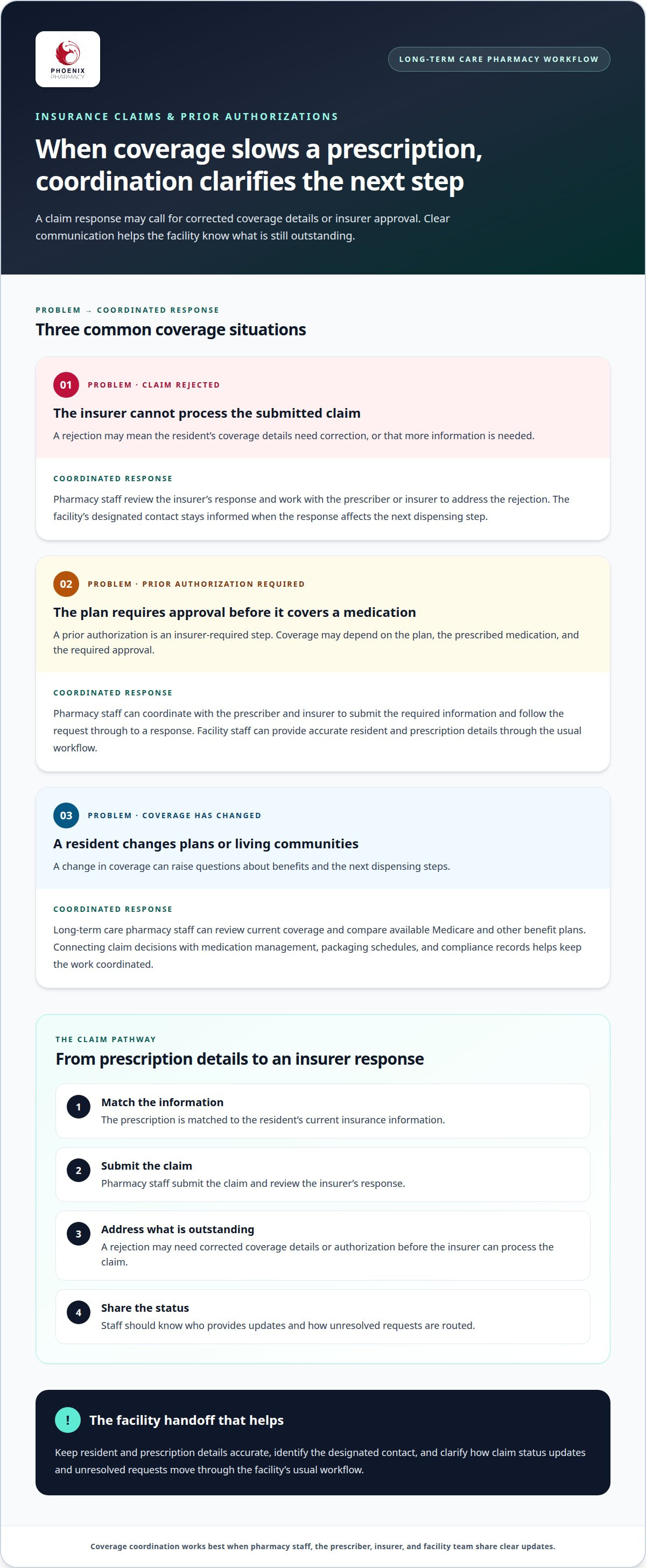
Medicare Part D, Medicaid, and private insurance cover medications according to each plan’s benefits. Coverage depends on the resident’s plan, the prescribed medication, and any required approval.
Claims processing begins by matching the prescription to the resident’s current insurance information. Pharmacy staff submit the claim, review the insurer’s response, and address rejections with the prescriber or insurer. For example, a claim may require corrected coverage details or authorization before the insurer can process it. Clear communication helps the care team understand what remains outstanding.
Prior authorization is a step an insurer may require before covering a medication. Pharmacy staff can coordinate with the prescriber and insurer to submit the required information and follow the request through to a response. The facility can support this process by providing accurate resident and prescription details through its usual workflow. Staff should know who will share status updates and how unresolved requests are routed.
Coverage questions can also arise when a resident changes plans or moves between living communities. Long term care pharmacy staff can review current coverage and compare available Medicare and other benefit plans. In long-term care facilities, this expertise can connect claim decisions with medication management, packaging schedules, and compliance records, rather than treating each task separately.
Pharmacy staff can explain claim status and identify whether authorization or corrected information is delaying processing. Keep the facility’s designated contact informed when a claim response affects the next dispensing step.
For facilities managing specialized prescriptions alongside routine refills, a clear point of contact can reduce back-and-forth between staff, prescribers, and insurers. Discuss prescription claim coordination as part of a facility pharmacy partnership.
Prescription review and clinical oversight
A pharmacist’s medication review considers each prescription alongside the resident’s broader medication profile. For a new order, the pharmacist checks it against other medications and raises concerns with the care team. This provides a clinical check before the order enters the facility’s medication workflow.
A review is especially useful when a resident’s regimen changes after a hospital stay or new diagnosis. A consultant pharmacist can assess the medication list and recommend that the prescriber consider therapy adjustments. The review can identify possible drug interactions, fall risks, and medication issues that may contribute to preventable hospital visits. The prescriber remains responsible for clinical decisions, while the pharmacist provides medication-focused findings.
Coordination matters. Pharmacy staff and community nurses can review and approve medication orders before administration, helping resolve unclear instructions, changed doses, or orders that conflict with the current record. Facilities can simplify this process by routing updates through a consistent channel and keeping medication records current. Staff and pharmacists then share a clear view of what was ordered and what needs follow-up.
Vaccination clinics also need to fit a facility’s clinical workflow. The pharmacy and care team can coordinate the clinic with resident medication records, identify who is scheduled, and document which vaccines were administered. For example, a resident’s current medication list can help the clinical team review relevant questions before the appointment. Clear records help staff keep the resident’s file and ongoing care plan current.
Pharmacy services support medication safety, but they do not replace the resident’s prescriber or nursing judgment. A useful review explains the concern, identifies the prescription involved, and gives the care team a clear next step. For nursing facilities, this practical handoff helps staff address medication questions promptly while leaving treatment decisions to the appropriate clinician.
Consultative partnerships with care facilities
A consultative partnership connects pharmacy support with the daily work of senior living communities. A consultant pharmacist can review residents’ medications and help the care team assess medication safety. A long term care pharmacy partnership works best when the pharmacist understands the facility’s routines, communication channels, and residents’ care needs.
Start with clear communication. Facility staff need to know where medication questions go, who receives pharmacy updates, and how recommendations reach the prescriber. For example, if a review identifies a possible interaction, the pharmacist can share the concern with the care team for follow-up. A long term care pharmacy provides medication-focused input; the prescriber makes treatment decisions.
Regular coordination also connects therapy questions with insurance and dispensing workflows. A prescription change may affect coverage or require updated records. When pharmacy and facility teams share relevant details through an agreed process, staff can route questions without restarting each handoff. Clear ownership helps keep the process moving.
When assessing a partnership, consider whether a named consultant pharmacist supports the contract, how staff reach that pharmacist, and how recommendations are communicated. Ask how medication reviews fit the community’s records and routines. These practical details show whether the relationship supports ongoing senior care. Explore a long term care pharmacy partnership to discuss how coordinated pharmacy support can fit your facility.
Long term care pharmacies can provide consultant pharmacist services to facilities, where medication reviews support appropriate and safe medication use. This brings medication-focused review directly into the care setting.
Phoenix Pharmacy: Long-term care pharmacy partnership
Phoenix Pharmacy provides long term care pharmacy partnerships for facilities seeking coordinated pharmacy support. A licensed pharmacist reviews prescriptions, including the dose and medication, before dispensing and delivery. The partnership gives your team a direct way to discuss how pharmacy workflows can fit the facility’s needs.
For facilities comparing long term care pharmacy support, Phoenix Pharmacy also provides prescription refills and transfers, the Phoenix Rx Kiosk, and Metagenics Adrenogen. These offerings serve distinct prescription and supplement needs.
Contact Phoenix Pharmacy to discuss facility services and whether a partnership fits your team.
Set Up a Pharmacy Partnership That Fits Your Facility
To get started, consider how pharmacy support should fit your facility’s day-to-day operations. Identify who will coordinate prescription questions, how staff will communicate medication changes, and which workflows need a clear pharmacy contact. A long term care pharmacy partnership gives your team a consistent structure for managing these touchpoints.
Phoenix Pharmacy provides facility partnerships as well as prescription refills and transfers. The Phoenix Rx Kiosk and Metagenics Adrenogen are also available for prescription pickup and supplement needs. Contact the Phoenix Pharmacy team to discuss how its services can align with your facility’s routines and priorities.
You don’t need to map every detail alone. Start a conversation about the needs your staff handles most often, then explore whether a partnership makes sense for your community. Contact Phoenix Pharmacy about facility services and take a practical next step for your team.
Frequently Asked Questions
Are there any extra charges for special packaging?
Discuss packaging in terms of residents’ routines and facility procedures. Consider whether residents need a format that makes doses easy to identify, whether staff can access medications as intended, and how the format fits recordkeeping. Share these details during setup so packaging instructions align with the facility’s workflow and residents’ needs.
How will my medications get to me?
For facilities, medication delivery is coordinated with the community’s receiving process. Designate who accepts deliveries and how staff route packages to residents. If you receive medication at home, keep your delivery address and preferred contact details current. Update the pharmacy when those details change so delivery instructions reflect your current arrangements.
What is a long-term care pharmacy and whom does it serve?
A long term care pharmacy is a closed-door pharmacy that operates separately from a public retail pharmacy. It serves care settings such as residential care, adult residential care, and hospice, where medication coordination involves facility staff as well as residents. This model is useful when prescriptions need to fit an ongoing care routine rather than a single retail pickup.
What services do long-term care pharmacies provide to nursing homes and assisted living facilities?
Pharmacy services can support medication needs during key transitions, such as a resident’s admission, return from a hospital stay, or change in orders. Facility staff can follow a consistent process to communicate the transition and ensure the current medication record reflects the resident’s plan. Align pharmacy communications with the facility’s admission and discharge procedures.
How are long-term care pharmacy services and medications billed, and what do they cost?
Medication claims are submitted under the resident’s applicable insurance coverage, while facility services follow the partnership’s billing arrangement. For clear reconciliation, distinguish whether a prescription claim processed from how facility services appear in facility records. The pharmacy can clarify claim status and billing documentation without treating them as the same item.
What federal and state regulations govern long-term care pharmacies in the United States?
Federal and state requirements can apply to pharmacy practice and medication services, with details shaped by the care setting and jurisdiction. A facility should identify the rules governing its operations and how its pharmacy partnership supports those processes. For example, staff may need clear procedures for maintaining medication records and routing compliance questions when facility policies change.


