

A prescription RX fill or transfer moves more smoothly when the pharmacy has the prescription details, prescriber information, and insurance information. Refill timing and coverage depend on the prescription’s status, order updates, and your plan’s rules. Learn what information to provide, how refills and transfers are handled, and what can affect when your medication is ready.
Key Takeaways
- Know which prescription details and label instructions help a pharmacy process a fill or refill accurately.
- Learn what order updates can tell you and which factors may affect when a prescription is ready.
- Understand why prescription validity and refill rules depend on the type of medication and the prescription.
- See how Phoenix Pharmacy’s refill and transfer service can help keep prescription tasks moving.
Prescription labels, instructions, and refills
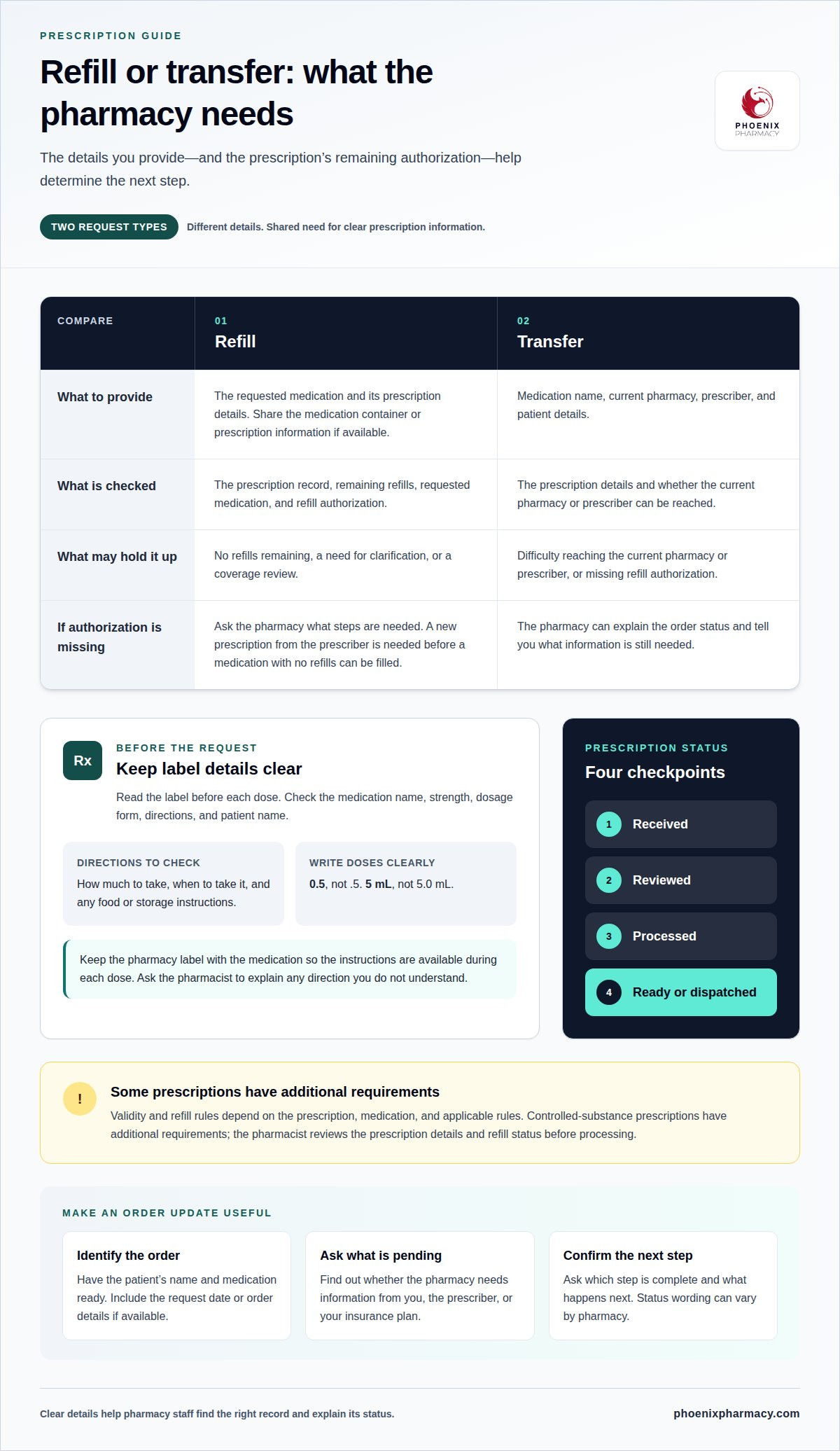
Read the label before each dose, and follow its directions. For refills, the pharmacy checks the prescription’s remaining authorization and order details.
Reading Prescription Labels and Instructions
Start with the medication name, strength, dosage form, and directions. Check how much to take, when to take it, and whether the label includes food or storage instructions. The patient’s name matters too, especially when family members take similar medications. Ask the pharmacist to explain any direction you don’t understand. Clear instructions help prevent mix-ups between a tablet, liquid, or different strength.
Decimal notation matters. Write 0.5, not .5, to avoid confusion with 5. Write 5 mL, not 5.0 mL, to avoid an unclear trailing zero. Keep the pharmacy label with the medication, so instructions remain available during each dose.
Refilling and Transferring Prescriptions
For a refill, the pharmacy reviews the prescription record, remaining refills, and requested medication. If no refills remain, ask the pharmacy what steps are needed to obtain more medication. To transfer a prescription, provide the medication name, current pharmacy, prescriber, and patient details. These identifiers help pharmacy staff find the right record and coordinate the transfer.
Processing depends on whether the pharmacy can reach the current pharmacy or prescriber and whether the prescription has refill authorization. Share the medication container or prescription details if available. The pharmacist can explain the order status and tell you what information is still needed.
Prescription Validity and Controlled-Substance Refills
In the United States, prescription validity depends on the prescription’s terms, the medication, and applicable rules. Check the date, directions, and refill information on the label. If no refills remain, the pharmacy needs a new prescription from the prescriber before it can fill the medication.
Controlled-substance prescriptions have additional requirements. The medication and applicable rules determine whether refills are allowed and what authorization is needed. The pharmacist reviews the prescription details and refill status before processing. A transfer involving a controlled medication may take a different course than a routine transfer.
Getting a Prescription and Checking Medication Effects
A doctor or other prescriber evaluates your health concern and decides whether a prescription is appropriate. Share your current medication list, allergies, and relevant health information during that visit. That record helps the prescriber consider the medications you already take and write directions suited to your treatment.
How can you check prescription drug interactions and side effects? Give your pharmacist a current list of medications and supplements, then ask about potential interactions and expected effects. Include over-the-counter products, as they can matter alongside prescriptions. If a label warning or instruction is unclear, ask the pharmacist before taking the medication.
Prescription tracking and order status
A prescription typically moves through several checkpoints: received, reviewed, processed, then ready or dispatched. Status updates indicate whether the pharmacy is handling the order or waiting for information. Since wording varies, ask what a specific update means. For a prescription RX request, ask which step is complete and what happens next.
Have the patient’s name and medication ready when requesting an update. Include the request date or order details if available. Ask whether the pharmacy needs information from you, the prescriber, or your insurance plan. A pending order may need clarification, refill authorization, or a coverage review. Knowing the specific hold-up makes the update more useful.
For several family members, keep status notes separate. One person’s order may be ready while another’s is still under review. A shared calendar can show who has an active request and when its status last changed. Add a brief note, such as “waiting on coverage review,” so another family member can follow up without repeating the whole conversation.
How does prescription delivery work, and what should you check when choosing a pharmacy? The pharmacy confirms the order is ready, verifies the delivery address, and explains its delivery arrangements. Ask whether your address is served, how delivery updates are shared, and how to reach pharmacy staff about a delayed order. Ask how insurance billing is handled, since coverage can affect the billing process.
Before choosing delivery, consider whether staff can explain order status clearly and answer questions about your medications. Direct updates help when family members have separate requests or pickup plans. For help organizing prescription refill support, use the available pharmacy contact option.
How long is a prescription valid in the United States?
There isn’t one expiration period that applies to every prescription nationwide. The usable period depends on the prescription and the rules that apply to it. Instead of relying on a general timeframe, use the information attached to that specific order and ask the pharmacy to explain its status.
When planning for your family, track the prescription’s status separately from the medication supply at home. A bottle with doses remaining doesn’t tell you whether another fill can be processed. Similarly, a calendar reminder for the next dose doesn’t establish how long the prescription remains usable. Track each patient’s order and current supply as separate details.
A simple family record can help make the next step clear:
- Record the medication and the patient it belongs to.
- Note the latest pharmacy update and any action still pending.
- Set a reminder to review the order before the supply runs low.
- Record the prescriber’s response if a new order is needed.
If a family member changes prescribers or pharmacies, mention the change during the next request. This context helps pharmacy staff find the right record and understand why an order may need review. If travel or a change in routine is coming up, raise the timing concern early. The pharmacy can explain the status of that prescription and the next step.
The person who issued a prescription may also be relevant when its status needs review. In the United States, licensed certified physician assistants have prescription authority in all 50 states and the District of Columbia, although some states limit their authority to prescribe controlled substances. In the United States, registered certified nurse practitioners and other advanced practice registered nurses can prescribe in all 50 states, the District of Columbia, Puerto Rico, and Guam, with some states limiting controlled-substance prescribing.
Veterinarians and dentists have prescribing power in all 50 U.S. states and the District of Columbia for animals and human diseases of the mouth, respectively. If there is a question about an order, ask the pharmacy whether it can be processed or whether the prescriber needs to review it.
What are the rules for controlled-substance prescriptions and refills?
Controlled-substance prescriptions need individual review. The prescription and applicable requirements shape what can be processed, so a general refill timeline may not fit every medication. Avoid planning around an assumed transfer date. A controlled-substance transfer may take 24-48 hours, so build that window into your family’s medication schedule.
For a household with several prescriptions, keep each person’s plan separate. Note who takes the medication, which pharmacy currently has the prescription, and whether a transfer is underway. This helps prevent one family member’s update from being mistaken for another’s and gives caregivers a clearer picture of which request needs attention first.
Coordinate timing before changing pharmacies whenever possible. If a move, trip, or change in routine is coming up, raise it with the pharmacy early. Ask about the expected timing for that specific transfer. Keep the answer with the patient’s medication notes instead of relying on a general estimate or another family member’s experience.
Requirements for controlled substances can differ from those for other prescriptions. The pharmacy reviews the individual order and explains the steps that apply. If information is needed to continue processing, direct the request to the right person, such as the patient or prescriber. A clear handoff helps prevent avoidable back-and-forth without assuming every prescription follows the same process.
Keep the current medication container and prescription information available during the transition. That gives pharmacy staff a reference for the specific order and helps caregivers keep records consistent. If you’re arranging a controlled-substance transfer, contact Phoenix Pharmacy for prescription help.
Phoenix Pharmacy: Prescription refills and transfers
Phoenix Pharmacy handles prescription refill and transfer requests, helping you move a family member’s medication order through the pharmacy process. Turn to the team when you need an eligible refill processed or want to transfer a prescription from another pharmacy. Providing the medication name, patient details, and current pharmacy helps staff find the right record and determine the next step.
If a prescription needs attention from its prescriber, the pharmacy can clarify what is needed to continue processing. Phoenix Rx Kiosk pickup and select Metagenics products, including Adrenogen and Adreset, are also available.
For help with a prescription refill or transfer, contact Phoenix Pharmacy.
Make the next refill easier to manage
Keep your family’s medication routine in one shared record. For each prescription RX request, note the patient, medication, current pharmacy, and next step. Update the record whenever a pharmacy or medication changes so you have useful details ready for the next refill conversation.
Phoenix Pharmacy handles prescription refills and transfers, and its pharmacy team can help process your request. The Phoenix Rx Kiosk and Metagenics Adrenogen are also available through the pharmacy. These options offer a practical next step, whether you’re organizing a family refill or considering a listed supplement.
Ready to discuss a refill or transfer? Contact Phoenix Pharmacy. Share the patient and medication details you have, and the team can guide the request. A little organization now can make the next medication handoff simpler for your household.
Frequently Asked Questions
What information does a pharmacy need to fill or transfer a prescription?
Have the patient’s full name, date of birth, and insurance card ready. For a transfer, identify the pharmacy that currently holds the prescription. A clear photo of the medication label can help staff match the right drug and directions, especially when family members take similar medications. Tell the pharmacy how you prefer to be contacted in case a detail needs clarification.
What are generic prescriptions, and how do they compare with brand-name drugs?
A generic prescription names a non-brand version of a medication, while a brand-name prescription identifies the branded product. The available option can depend on the prescription, the product, and coverage rules. If the pharmacy offers a different version than you expected, ask the pharmacist to explain the medication and any differences relevant to your situation. Don’t change or substitute a medication on your own.
How do prescription refills and renewals work?
A refill uses authorization already attached to the prescription. A renewal asks the prescriber to issue or update that authorization. For example, if a treatment plan changes, the prescriber may need to review the current directions before sending an updated order. The pharmacy can relay a renewal request, but the prescriber makes the treatment decision. Share any recent changes with the care team.
What can a pharmacist do if you lose or run out of a prescription?
Call the pharmacy and explain whether the medication was lost or you’ve run out. The pharmacist can review the prescription record, identify available authorization, and explain the next step. If the order needs a new prescription, the pharmacy can direct the request to the prescriber. Have the medication name and patient details ready to help staff find the right record.
What does Rx mean on a prescription?
Rx refers to a prescription.


