

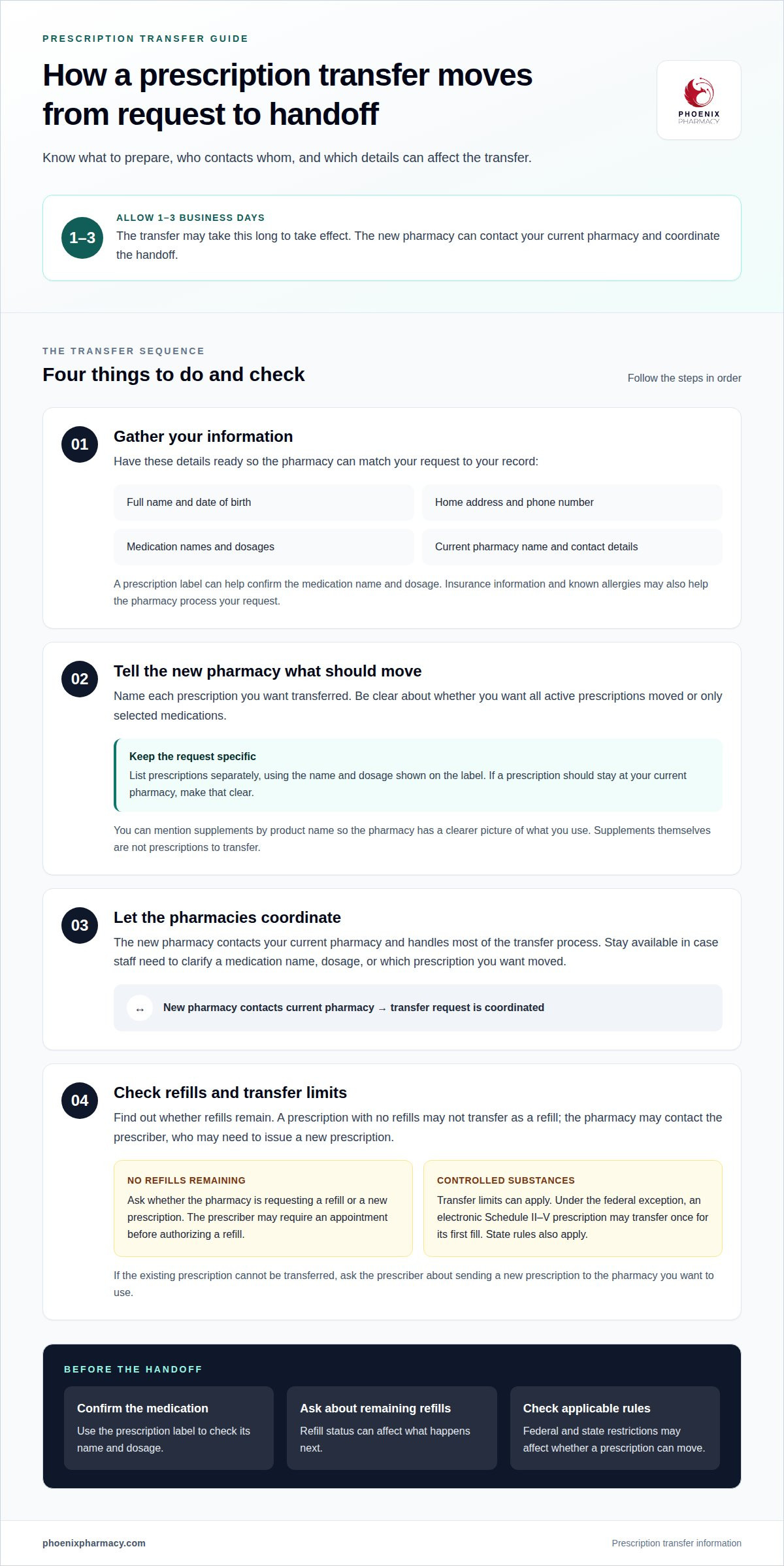
To transfer a prescription to a local pharmacy, ask the new pharmacy to contact the one that currently fills it, and allow 1-3 business days for the transfer to take effect. Have your full name, date of birth, contact details, medication names and dosages, and current pharmacy information ready; insurance and allergy details may also help the pharmacy process your request.
You can transfer a prescription to a local pharmacy before you need a refill, but refill status and controlled-substance rules can affect the next steps. Here’s what information to provide, how pharmacies coordinate the handoff, and what limits to keep in mind.
Key Takeaways
- Have your identifying details, medication names, and current pharmacy information ready to help start the request.
- The new pharmacy can contact your current pharmacy and coordinate the transfer for you.
- Check whether refills remain, since that can affect whether a prescription can move as requested.
- Controlled-substance prescriptions may have additional transfer limits, so the pharmacy will need to follow the rules that apply.
How does a pharmacy transfer a prescription between pharmacies?
Before requesting a transfer, find out whether refills remain, what details the pharmacy needs, and whether restrictions apply. Start by identifying the medication and the pharmacy currently filling it.
-
What to Provide for a Prescription Transfer
Give the pharmacy your full name, date of birth, home address, and phone number so staff can match the request to your record. Name each medication you want transferred and provide the current pharmacy’s name and contact information. If you have several prescriptions, list them separately to make the request clear.
Have the prescription label nearby. It can help you confirm the medication name and dosage accurately. Ask whether refills remain, since that affects what can happen next.
-
Provide Details to the Pharmacy
Share your prescription insurance information, if applicable, and tell the pharmacy about any known allergies. Provide a phone number where staff can reach you if they need to clarify a medication name or dosage. If details such as your address have changed, give the current information rather than relying on an older pharmacy record.
For multiple prescriptions, list each medication clearly. For example, distinguish a tablet from a capsule if that is how the label describes it. Clear details help reduce mix-ups when the pharmacies coordinate.
-
Share Medication and Supplement Information
Tell the pharmacy which prescription medications you want transferred, including each name and dosage as shown on the label. You can also mention supplements by product name. Supplements are not prescriptions to transfer, but sharing their names gives the pharmacy a clearer picture of what you use.
Keep your list focused on the prescriptions you want moved. If you want all active prescriptions transferred, say so. If you want only selected medications, name each one so the pharmacy can make a specific request.
How the new pharmacy contacts your current pharmacy
Ask the new pharmacy to contact your current pharmacy and coordinate the transfer. If no refills remain, the prescription may not transfer as a refill. The pharmacy can contact the prescriber about a new prescription.
- Tell the new pharmacy which prescriptions you want transferred and identify the current pharmacy by name and contact information. The new pharmacy contacts the current one and handles most of the process. You can ask the new pharmacy to coordinate the transfer rather than contacting the current pharmacy yourself.
Be clear about whether you want every prescription moved or only selected medications. For example, name the specific medicine if another active prescription should stay at the current pharmacy. This helps both pharmacies act on the same request.
- Ask the new pharmacy what happens if a prescription has no refills left. A transfer request may be denied when no refills remain. In many cases, a pharmacy can request a refill on your behalf, but the prescriber may need to issue a new prescription.
If the pharmacy contacts your clinician, ask whether they’re requesting a refill or a new prescription. The clinician may require an appointment before authorizing a refill. A long gap since your last visit may lead the clinician to require an exam or blood work before deciding whether the medication remains appropriate.
- Stay available in case the pharmacy team has questions. Missing medication details or uncertainty about which prescription to move can slow the handoff. Provide the requested information, and ask which pharmacy will fill your next prescription.
If your clinician sends a new prescription directly to a different pharmacy, that pharmacy becomes the pharmacy of record. This may be the next step when the old prescription has no refills left. Before contacting the new pharmacy, you can ask your doctor’s office whether refills remain.
Prescription transfer limits and regulations
A prescription cannot be transferred when applicable federal or state rules prohibit it; restrictions vary by state. Under the federal rule, an electronic controlled-substance prescription may be transferred once for the first fill.
Use these steps to identify possible restrictions before the pharmacies begin the handoff.
-
Review Prescription Transfer Limits
Tell the pharmacy if the prescription is for a controlled substance, then ask which transfer rule applies. Controlled-substance prescriptions may be subject to transfer limits, so ask the pharmacy which rules apply. Under the federal exception, an electronic prescription for a Schedule II-V controlled substance may transfer once for its first fill.
The Drug Enforcement Administration requires a transferred prescription to remain electronic and unchanged. It must pass directly between two licensed pharmacists, and the receiving pharmacist must follow and record the required transfer details. State rules also apply, so a transfer allowed under federal rules may still face state restrictions.
-
Identify Prescriptions That Cannot Be Transferred
Give the pharmacy the medication name and ask whether its prescription can be transferred under the applicable rules. A prescription with no refills remaining may be denied for transfer. If it’s a controlled substance, its schedule and whether it’s an electronic prescription for a first fill affect your options.
Some medications, including Ambien (zolpidem), Tylenol #3 (acetaminophen/codeine), and testosterone, have limited transfer options and can transfer only once. A pharmacy may also be unable to accept or initiate a request because of legal restrictions, medication availability, or policy. If the existing prescription cannot move, ask the prescriber about sending a new prescription to the pharmacy you want to use.
How your current pharmacy handles a prescription transfer
Your current pharmacy is the pharmacy of record, so it must be involved in the transfer. You can ask its team to send the prescription to your new pharmacy.
- Tell the current pharmacy which prescription to transfer and name the receiving pharmacy. The current pharmacy reviews the request and coordinates with the new pharmacy. If you want only selected medications transferred, give clear instructions. For example, specify which medicine to move if another prescription should remain at the original pharmacy.
The pharmacy handling your prescription may need to communicate directly with a pharmacist at the receiving location. According to the Drug Enforcement Administration, electronic prescriptions must remain electronic and unchanged during transfer. This keeps the prescription details intact throughout the handoff.
- Ask the current pharmacy how long the transfer is expected to take. The timing depends on workload, staffing, and availability at the pharmacies involved. In the United States, allow 1-3 business days for a transfer to take effect. If you need the medication soon, share that timing concern when you make the request.
Ask whether the pharmacy has sent the prescription and whether the receiving pharmacy has what it needs to proceed. This gives you a clear point of contact if the handoff stalls. Don’t assume a transfer request means your next fill is ready; the receiving pharmacy must complete its part.
- If the current pharmacy cannot transfer the prescription, ask for the specific reason. Refill status, transfer restrictions, or missing prescription details may affect the next step. When no refills remain, the pharmacy may need to contact your doctor, or your doctor may send a new prescription to the pharmacy you choose.
Keep the current pharmacy and prescriber aligned. Tell the pharmacy if your doctor has already sent a new prescription, so staff can avoid duplicate requests. Request help with a prescription transfer when you want a pharmacy team to handle the process.
Phoenix Pharmacy: Prescription refills and transfers
Phoenix Pharmacy handles prescription refills and transfers, coordinating the move with your current pharmacy. Share the medication names and your current pharmacy’s details to get started. If no refills remain or transfer restrictions apply, the next step may depend on your prescriber and the rules for that prescription.
For another way to access pharmacy services, Phoenix Rx Kiosk offers prescription pickup. Phoenix Pharmacy also carries Metagenics products, including Adrenogen and Adreset.
Ready to discuss a prescription transfer or refill? Contact Phoenix Pharmacy.
Make your next refill easier to manage
Use the switch as a chance to set a simple routine for future pharmacy needs. Decide who in your household tracks refill reminders and where you keep medication labels. When a clinician changes a medication, update your own list so you can describe the change accurately. These habits can help you stay organized and make future pharmacy conversations easier.
Think ahead about how you’ll handle pharmacy changes in the future. Keeping a clear record of your preferences can help you explain what you need if your routine or circumstances change. Start with an approach that feels manageable, then adjust it as your needs evolve.
Phoenix Pharmacy’s team can help with prescription transfer questions. Contact Phoenix Pharmacy to discuss your next step and move forward with confidence.
Frequently Asked Questions
How long will it take to get my prescriptions?
Phoenix Pharmacy reports that most prescription transfers are ready the same day. This may help if you’re changing pharmacies close to your next refill. Keep in mind that completing the transfer and having medication ready for pickup are separate milestones. Ask the pharmacy handling the request for updates on both, especially if you need to plan around your current supply.
How can a pharmacy transfer a prescription to a local pharmacy?
You can start a transfer by phone, in person, or online, depending on the pharmacy’s available options. A practical approach is to contact the pharmacy you want to use and ask it to coordinate the move. You can start before you’re ready for a refill, giving the pharmacies time to handle the request in advance.
What information should I provide to transfer a prescription?
Provide identifying details and the names of the medications you want transferred. If you have the prescription container, its label can help you give the exact name and dosage. The prescription number on the label may also help staff find the record. Share allergy or insurance details if they apply, and list supplements separately from prescriptions.
Can a pharmacy transfer prescriptions between different pharmacy chains?
Yes. A transfer can involve pharmacies from different chains; they don’t need to belong to the same company. The pharmacy currently filling the prescription still needs to participate. If your prescriptions are at multiple locations, identify which pharmacy holds each one so the new pharmacy can direct its requests correctly.
How long does a prescription transfer usually take?
There’s no single timeline for every request. The number of prescriptions and the workload at both pharmacies affect how long coordination takes. Ask for separate updates on transfer status and expected pickup timing. That distinction helps you plan, since completing the handoff doesn’t indicate when the medication will be ready.
How do controlled-substance prescription transfers work in the US?
For the first fill of an electronic controlled-substance prescription, ask the pharmacy specifically to request the transfer under the federal first-fill exception. The transfer must meet applicable rules, and state requirements can also affect whether it proceeds. Identify the medication and ask the pharmacy what steps it needs to take.


